
 |
Health Conditions |
Boils |
|||||||
General Description Causes Medical Treatments |
|
||||||
<!–
–> |
|||||||
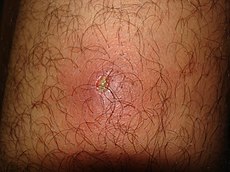
A boil is a localized skin infection. The involved area develops a red, raised sore that is filled with pus. The sore is often sensitive to light touch. The skin thins out in the center, and a whitish-yellow point forms. This ruptures within two to four days, spilling out the enclosed pus. Boils may form almost anywhere on the body but are most commonly encountered on sites of hair-bearing skin subject to friction and maceration such as the buttocks, neck, face, underarms, and thighs. Boils may be spread from person to person by close contact. Hence athletes participating in contact sports such as football and wrestling are prone to boils
Causes
Most boils are caused by the Staphylococcus germ.
Medical Treatments
Never squeeze a boil! Squeezing and picking at these sores may spread the infection and leave scars. Small boils are best treated with hot, moist compresses applied three to four times a day. The area should be frequently washed with a strong antibacterial soap such as Dial or Safeguard. When the boil begins to drain, pus should be removed as it forms and not allowed to contaminate surrounding skin. An antibacterial ointment may be applied around the base of the lesion. Large boils, especially those occurring on the face, should be treated by the family doctor or dermatologist. He or she may wish to carefully open the boil, inject an anti-inflammatory suspension, and/or administer antibiotics internally by mouth. Towels, linens, and clothing used by a person with a boil should be kept separate until thoroughly washed.